Plasma horizontal position feedback control based on Reflectometry Diagnostic at J-TEXTPlasma horizontal position feedback control based on Reflectometry Diagnostic at J-TEXT.docx
Plasma horizontal position feedback control based on Reflectometry Diagnostic at J-TEXTPlasma horizontal position feedback control based on Reflectometry Diagnostic at J-TEXT
In tokamak experiments, real-time (RT) plasma position measurement and feedback control are essential for the operation of the tokamak. Magnetic based axisymmetric measurement is used to perform this control task in most tokamaks. However, in the J-TEXT tokamak, when the resonant magnetic perturbation (RMP) is applied, magnetic measurement will be affected, resulting in large plasma position measurement error. Reflectometry diagnostic as a nonmagnetic based diagnostic will not be affected by the RMP. It measures the electron density profile of the plasma and it can be used to determine the plasma position and edge. Thus it can be used as a backup or complement to magnetic-based position measurement. In order to implement the real-time reflectometry diagnostic, we upgrade the existing data-acquisition system (DAS) to make sure it can process data in real-time and transfer data with very low latency. Field Programmable Gate Array (FPGA) with four fast digitizer channels is used to acquire and process data, which can calculate the electron density profile without transferring the data to the CPU. Reflective memory card is used to transfer electron density profile data from real-time reflectometry diagnostic system to plasma control system (PCS). This system is tested at J-TEXT. The results showed this system is capable of producing electron density profile in real-time and would improve the accuracy of plasma horizontal position measurement when RMP is applied during the experiments at J-TEXT
I . INTRODUCTION
在托克马克装置中,对等离子体位置进行控制大都是基于磁诊断获取等离子体的位置信息,然后提供给等离子体控制系统对等离子体位移进行实时控制。但是,在长脉冲的等离子体放电中,基于磁诊断的位移测量会带来很大的测量误差,所以基于反射仪诊断的等离子体位移测量作为ITER一种后备或者替代的位移测量手段被提了出来[ 1] 。在J-TEXT托卡马克中,当扰动场投入时会影响基于磁诊断的位移测量,所以本文提出了基于反射仪诊断的实时密度剖面反演计算系统,并将其用于等离子体位置控制系统。
In the tokamaks, the plasma position control is mostly based on magnetic diagnosis to obtain the plasma position, and then provide it to the plasma control system (PCS) to control the plasma position in real time. However, in the long-pulse discharge, the position measurement based on the magnetic diagnosis will bring great measurement errors, so the plasma position measurement based on the reflectometer diagnosis is proposed as a backup or alternative measurement method for ITER. In the J-TEXT tokamak, when the resonant magnetic perturbation (RMP) is applied, it will affect the position measurement based on magnetic diagnosis. Therefore, this paper proposes a real-time density profile inversion calculation system based on reflectometer diagnosis, plasma position can be obtained by the system and transfer it to PCS.
II . BACKGROUND
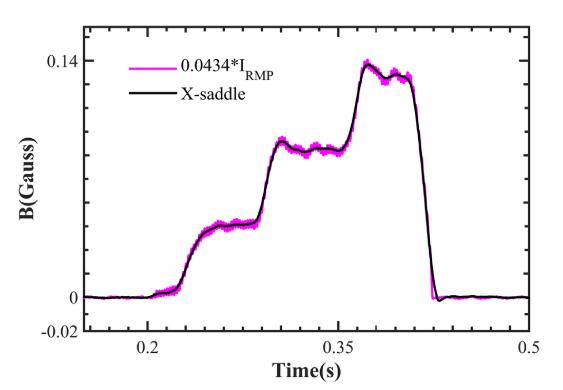
微波反射仪诊断可以用来测量等离子体截止层的密度,从而获取等离子体的密度剖面分布。在J-TEXT托卡马克装置中已经发展了一套多路多模微波反射仪诊断系统,主要工作模式有Q波段O模,Q波段X模,V波段X模[ 2] 。Q波段的频率范围是33~50GHz, V波段的频率范围为50GHz~75GHz,每20u s 对等离子体进行一次扫描,可探测密度范围从 。在J -TEXT 装置中当扰动场( RMP) 投入时,基于磁诊断测量的水平位移会受到影响[ 3]. 如图二所示,系数大概为0.0434.
Microwave reflectometer diagnosis can be used to measure the density of the plasma cut-off layer to obtain the density profile of the plasma. A set of multi-channel multi-mode microwave reflectometer diagnostic system has been developed in J-TEXT, including Q-band O mode, Q-band X mode, and V-band X mode [2]. The frequency range of Q-band is 33~50GHz, and the frequency range of V-band is 50GHz~75GHz. Microwave sources can be swept every 20us, and the detectable density ranges from 0-3.1×10^19 m^3. When RMP is applied in the J-TEXT , the horizontal position based on the magnetic diagnostic measurement will be affected [3]. As shown in Figure 1 , the coefficient is approximately 0.0434.
In order to improve the accuracy of plasma position measurement when RMP is applied ,a real-time density profile inversion calculation system based on microwave reflectometer diagnosis was developed in J-TEXT. This system can produce the density profile in real time within a control period of 1ms .also, plasma horizontal position can be obtained through it,and it will be sent to the PCS system for plasma position control.
III . DENSITY PROFILE MEASUREMENT AND PLASMA HORIZONTAL POSITION FEEDBACK CONTROL
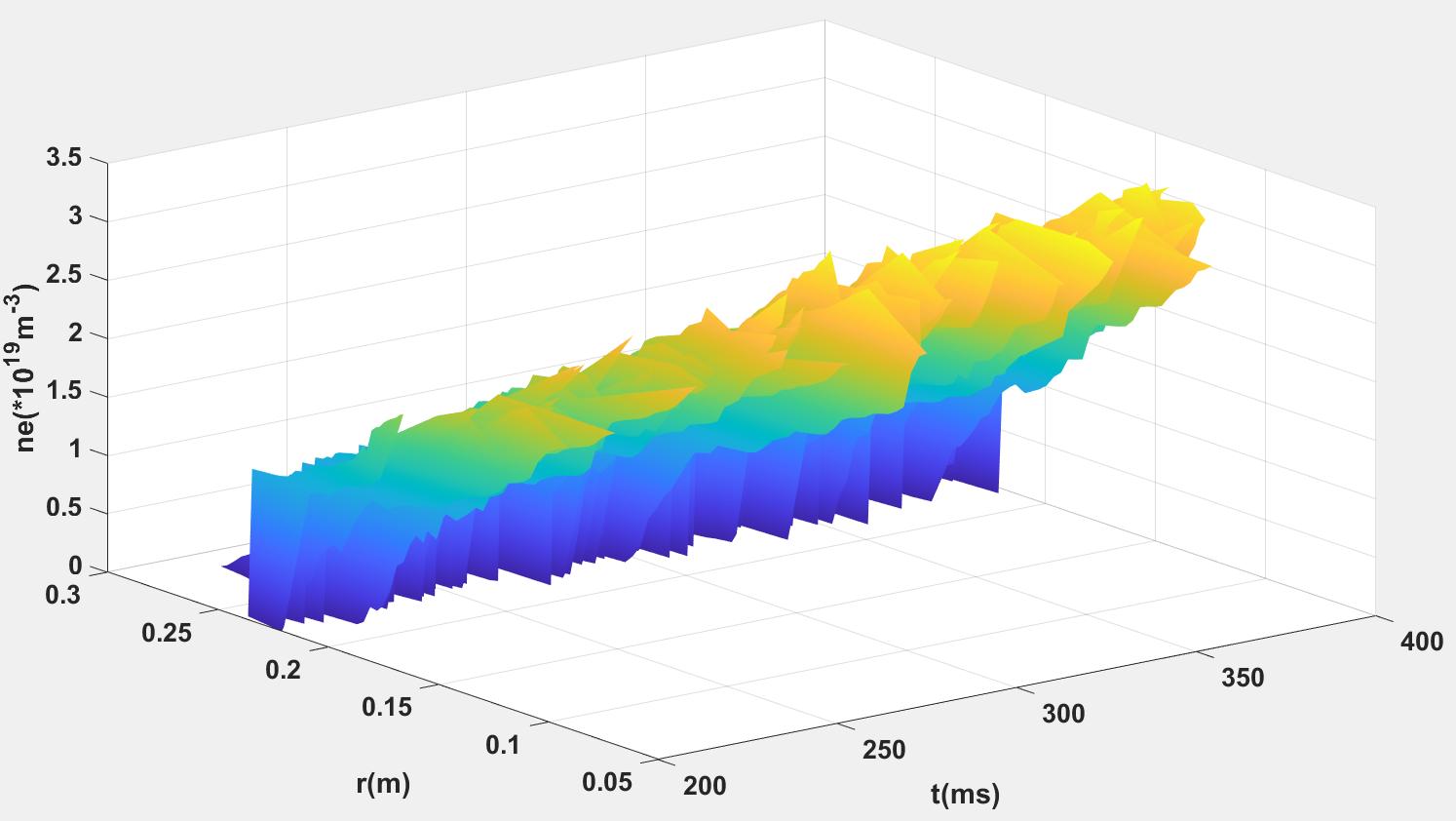
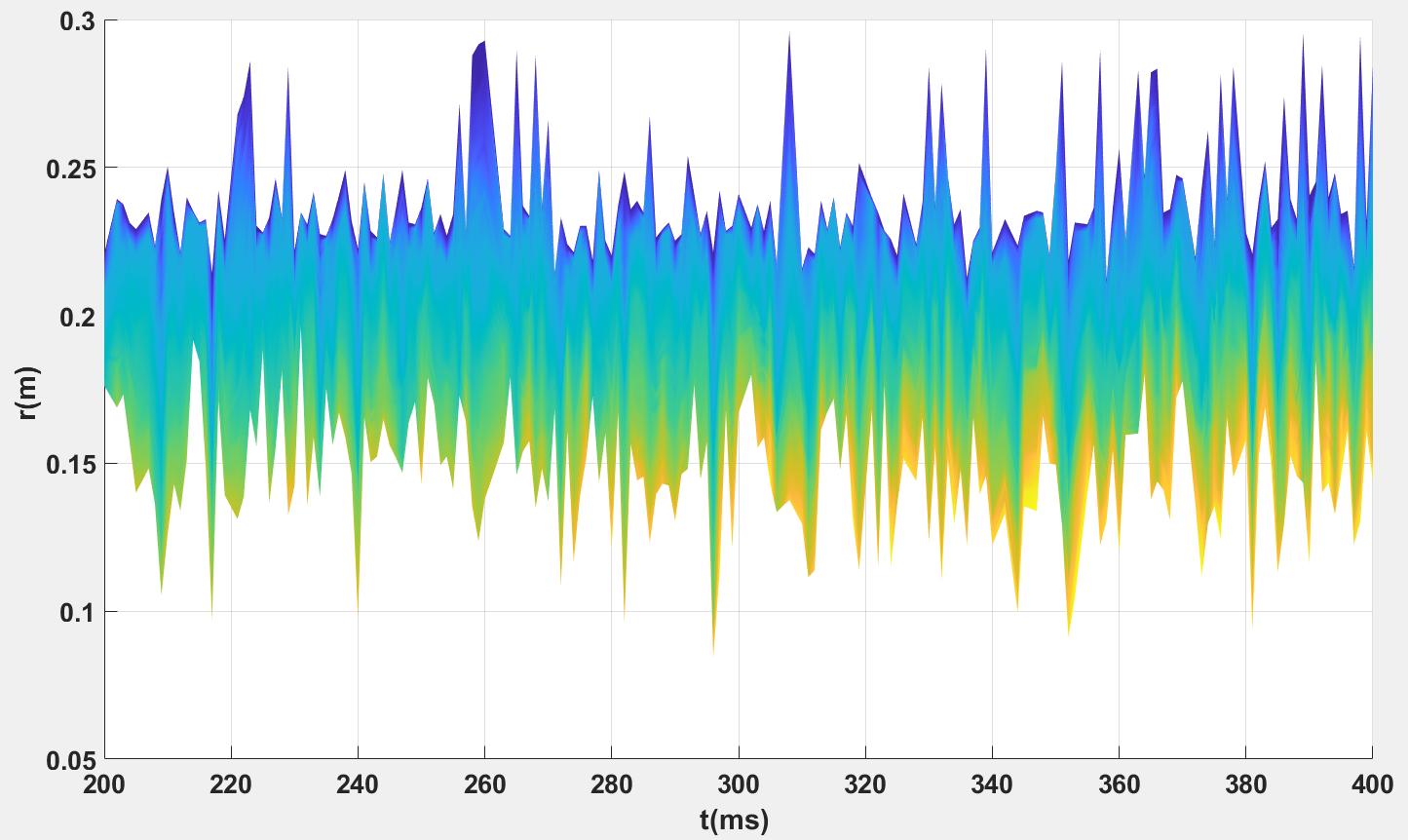
通过微波反射仪诊断反演算法算出来的1061496炮的离线密度剖面如图2所示,位移随时间变化如图3所示:
1. 算法
in order to obtain the horizontal plasma position through the density profile, the control algorithm is as follows:
for low-density discharge, when the microwave system produces the density profile, we can obtain the center density and position, the horizontal displacement can be calculated through the difference between adjacent center position.
当J -TEXT 在高密度放电条件下时,由于微波反射仪诊断无法探测到中心密度点,但是在每一个托卡马克装置中,其中心的线密度与分离层的密度有一个系数关系,可以通过J -TEXT 上的偏振仪诊断来实时获取中心线密度,并将其通过反射内存卡实时传输到微波反射仪实时数据处理系统,从而可以得到中心密度的位移dx。
将计算出来的等离子体位移dx写入反射内存卡传输到等离子体控制系统( PCS) 进行位移控制
2. 实现
整个等离子体基于微波反射仪的微波反射仪整体实现如下图所示:
在硬件方面我们采用了N I 公司的P XIe-8840 实时嵌入式控制器以及P XI e -7966R F PGA 板块对数据进行采集与处理,P XI e -7966 FPGA 板卡结合N I 5734 适配器能够最高提供120 M 的采样率,同时F PGA 拥有非常多的资源能够用于数据的实时处理,P XI e -8840 控制器能够提供 1ms 精确的软件定时,将计算得到的等离子体水平位移输出到等离子体实时控制系统用于位移控制。
在软件方面我们采用两个状态机分别来对数据进行采集和计算处理,数据采集状态机采集数据完成后,通过F PGA 内部F IFO 将数据传输到计算状态机利用剖面反演算法对等离子体位移密度剖面进行计算,计算完成后通过F PGA 传输到主机F IFO ,主机再将计算出的等离子体水平位移写入到反射内存卡,供等离子体控制系统读取并用于等离子体水平位移控制。
IV . SYSTEM PERFORMANCE
我们将基于微波反射仪实时剖面计算系统在J -TEXT 进行了测试,当没有R MP 投入时,基于磁诊断与基于反射仪的水平位移计算结果如下图所示,从结果可以看出来 ……
当有R MP 投入时,基于微波反射仪诊断测量的结果如图所示,从S XR 重建位移可知 ……
V . CONCLUSION
基于微波反射仪的实时在线密度剖面计算现在正在 J-TEXT 装置进行测试,测试结果表明其可以在1ms的控制周期内实时计算等离子体密度剖面并提供水平位移信号用于等离子体控制系统,可以作为J -TEXT 装置的位移控制系统的一种替代手段。
本文章由word文档转换而成